The rotting bonsai ficus
For several years, Wendy travelled around with me to every apartment I lived in, faithfully adapting to each new environment that I subjected her to. Some places were dim, others bright, but it didn’t matter; Wendy thrived.
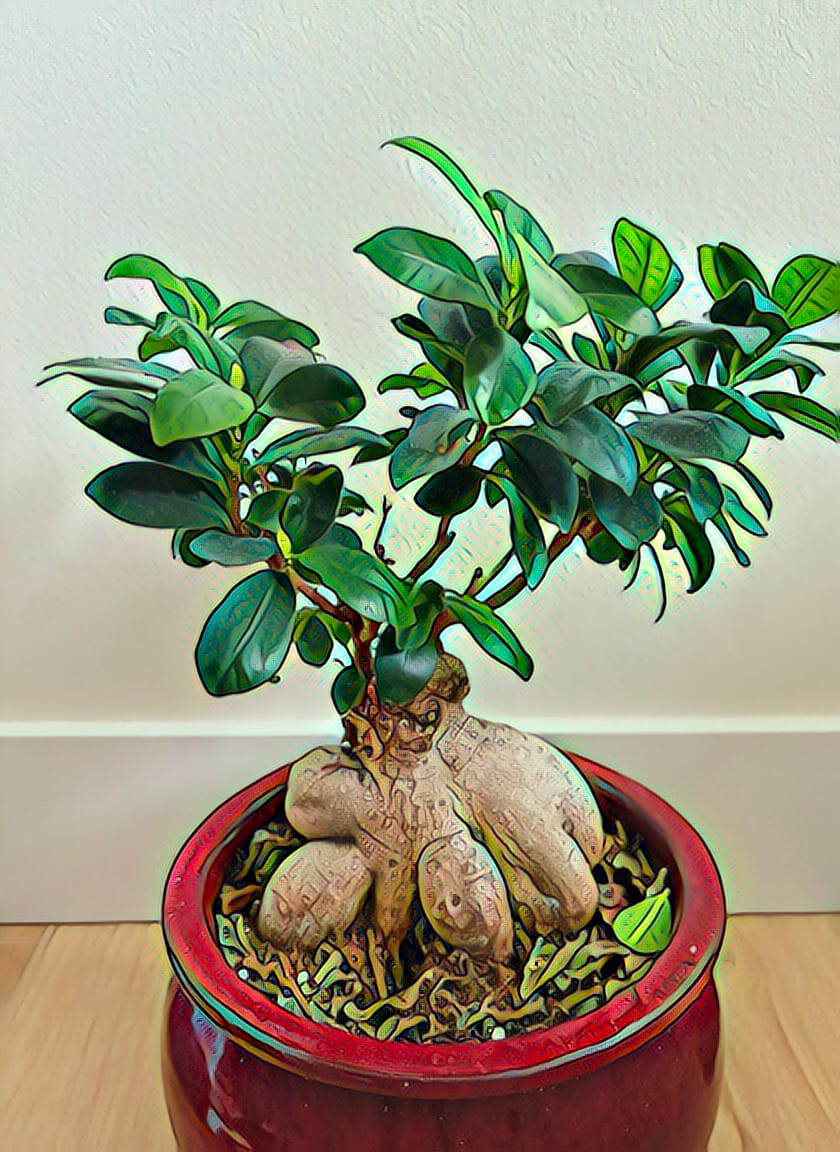
Fifteen years ago, I bought a bonsai ficus at the Richmond night market. I hadn’t planned on doing anything that Saturday night, but my friend Wells sent me a text message saying he and my friend Nav were headed to my apartment with beer.
Are we just going to chill at my place then? I replied to him.
No, night market.
We arrived at the market around nine o’clock, and I already had a good buzz on thanks to the oversized Sapporo bottles I’d been sipping on in the backseat of Wells’ Cavalier. The flashing neon signs at the market entrance, lowered import cars blasting rap music in the parking lot, and crowds of girls in short skirts suggested it could be an interesting night. In fact, it turned out to be a pretty boring evening. We explored the shops, ate bacon-wrapped rice balls, and drank more beer. We were on our way back to the car when I saw a booth filled with bonsai trees.
We’ve got to check out the bonsai trees, I said to Wells and Nav.
I noticed a stout bonsai ficus in a tan ceramic pot with two large, bulbous roots that transitioned into a thick trunk. Two of her defining branches had been bent downward toward her roots and interlaced to give the appearance of clasped hands. Maybe it was the alcohol, but that short, fat little ficus had personality. There was a kindness to her.
“The asians think these trees have souls, buddy,” Wells said, gripping my shoulders and shaking me from behind.
“I’ll give you a good price,” the old woman said from behind the cash register.
I’ll take her, I replied. Fifty is fine.
I managed to get the little tree back to Wells’ car without dropping her. Wells had a smoke, and we started the trip back home.
“What are you going to name her?” Nav asked me on the car ride home.
I don’t know. I don’t typically name my plants. I’ve never had a bonsai before.
“She looks like a Wendy,” he said.
Wendy, it is.
For several years, Wendy travelled around with me to every apartment I lived in, faithfully adapting to each new environment that I subjected her to. Some places were dim, others bright, but it didn’t matter; Wendy thrived. I watered her randomly, rarely pruned her branches, and only gave her fertilizer once or twice a year, yet this was enough. Wendy was easy. This approach to bonsai care went on for years until I bought my first apartment in Kitsilano with my fiancée. I situated Wendy on the island in our new kitchen, and true to her nature, she seemed to be adjusting well until one morning, when I noticed a dark spot on her main root. I gently touched the spot with my index finger, and my fingernail penetrated her once-tough bark. She was rotting. Panicked, I felt around the circumference of her other roots and noticed additional soft spots. How did this happen so quickly? I thought to myself. You were doing just fine, Wendy.
Unfortunately, the rot had spread too far up into her body, and I couldn’t completely clean it out. I let her decompose in the garden bed on the deck of my apartment. I’m not sure what led to the root rot, but several things can cause it. Since Wendy’s demise, I’ve attempted to raise several bonsai trees, and I’ve killed all of them. None of them have been as easy as Wendy. Discouraged, I stopped buying ficuses, but last year, someone encouraged me to try again.
Last April, on my 40th birthday, I received a bonsai ficus from my sister-in-law. It even looked a bit like Wendy. I promised myself that I’d keep her alive, but by July, dead leaves were collecting in the dirt at the top of her pot. I contemplated returning her to my sister-in-law, who’s a legitimate green thumb, before I could do any additional harm. Like the previous trees, I hadn’t been watering this one much, just once in a while, when the soil got very dry. Again, this approach had always worked for Wendy. But it did occur to me, out of nowhere one day, that I wasn’t watering this tree, or the previous ones, enough.
I tested my hypothesis and started watering the tree every other day with just enough fluid to keep the top of her soil moist. Within a week, her leaves stopped dropping, and I noticed new buds on the tips of her branches in the days that followed. Her greens deepened in hue, her branches strengthened, and it was clear that she was going to rebound. It’s actually amazing what a little water can do for a tree — who would have thought.
Reflecting on how quickly this tree came back from the brink, it was clear that I was so worried about rot that I forgot that trees die of thirst, too. While it seems painfully obvious now, it’s very easy to convince yourself that some living thing’s resiliency is a common trait of a class of things. With Wendy, neglect as a form of care worked, but I had gotten lucky. Wendy was an outlier, and apparently, a good teacher.