A fall coho, from the beach
It’s Thanksgiving Monday in Canada, a holiday. It’s been raining for three days straight, but I can no longer hear the rain hammering against my roof and bedroom window. The storm has finally blown through Saanich. I reach for my phone, which is stuck to the magnetic charging stand on my bedside table, and touch the screen. It’s 4:45 am. My wife and son are sleeping next to me; he must have crawled into our bed in the early morning. I wonder if I left his bedroom window open, allowing the cold October air to slip in and chill his small body. Both of them are breathing quietly, still, and I slowly roll over in bed until my back’s to them to shield the blue light from my phone’s screen. I check the tide. There’s got to be a coho lying around in the bay this morning, I think to myself. And I bet I can make it to the beach and back home before they’re out of bed.
The more you fish, the closer you get to nature. I don’t consider myself particularly well-versed in the stars, moons, temperature, and tides, and the interplay of these variables, but I’ve fished enough to feel a fishy day, and last Monday felt fishy. I try not to overthink this intuition when it arises, but when it does, I respect it and do my best to put myself in the right place at the right time. Often, this means getting to a beach very quickly, even if it means blowing off pesky responsibility.
I roll out of bed, pull on my dirty, gravy-stained shirt I wore to Thanksgiving dinner last night, and grab an extra sweater from my closet, carefully minding the weight of my footsteps as I move across the hardwood floor in our bedroom. I grab my seven-weight rod, beach flies, and wading gear and toss them in the back of my very dirty SUV. There’s a hard plastic disk of flies in the centre console of the GLC, compliments of Robinson’s Fly Shop. I didn’t have time to spin up any patterns this weekend, but I did manage to pay a visit to Matt King to grab some blue and silver coho buggers. “Getting any fishing in lately?” Matt asked as he rang in my order. “I’ve been swinging in my dreams,” I reply, “but I am going to hunt some coho this weekend.” “Good luck, man. They’re around.”
I pick up an extra-large black coffee from Tim Hortons, the only option available in Gordon Head at 5:30 am on a holiday, and I speed to the beach. I do not turn on music, I do not cue up a podcast. I drive in silence, sipping my coffee, on the lookout for deer. The sky is still black, but I know there will be a deep wall of yellow, orange, and red trees to greet me on my drive back home later this morning. There is no one else on the road, and it’s a bit lonely, knowing that everyone else for miles is asleep in their beds. I break several speeding laws on the way to the ocean; it’s no bother, and I don’t care. Statistically, the odds of getting caught speeding at this time of day are very low, and there’s no danger to other drivers or cyclists. Sometimes, you know the risk is low, and you exploit it — I can’t let another angler beat me to my favourite spot.
On the way to the fishing grounds, I think about our Thanksgiving dinner last night and what it means to be grateful. It takes a lot of effort to be grateful, I say to myself aloud in the car, looking into my own eyes in the rearview mirror. Being grateful doesn’t come naturally to most people. It doesn’t come naturally to me. Humans are wired to notice what’s missing in their lives — we’re programmed to find the lack. To me, being thankful means recognizing when things in life are, for the most part, lining up for us. This means taking time to acknowledge that life is alright and that there’s some good in it, even if our circumstances are less than perfect. This is both easy and difficult, but it’s critically important to give the universe a nod and a wink once in a while to show you’re paying attention. I see what you’ve done there, universe. Keep it up. This is grand, you might say to yourself.
I arrive at the parking lot, and there’s only one truck parked, but I can tell this is not a fisherman’s truck. Sometimes you just know. The first rays of sun are just starting to crack into the black sky, and the bit of space hanging overtop the mountains is starting to glow bright fall orange. The wind has died, the water is calm, and the air is cold enough to see my breath. I build my ten-foot seven-weight Sage Sonic and pull on my summer waders. It will be the last time I use them this year. As I’m fastening my stripping basket to my waist, I hear a splash in the shallows of the bay. Probably a sea-run trout. I slowly wander down the hill to the beach, trying to make out the surface of the water with my headlamp. Not a person in sight, and the bay itself appears free of masses of kelp, seaweed, and other debris that make casting a fly a nightmare. Sometimes, things just fall into place.
I tie on the silver coho bugger Matt sold me and flatten the barb down with my hemostats. The hook is dangerously sharp. That dog’ll hunt, I whisper into the disappearing darkness. I work a strip of beach for twenty minutes or so and see no swirls on the surface of the water, no fish jumping, no silver bolts catching the early morning light. The sky is starting to brighten, and the tide is rising, so it’s time to move towards the creek that connects into the bay. I put my bugger in a patch of still water that has moving water around it — it feels fishy. I don’t know how I can tell there is a fish there, but there is. I am connected to this place today; the fall air woke me from my turkey-and-wine-induced slumber and brought me to this beach. I believe the sea is going to provide me with worthy quarry.
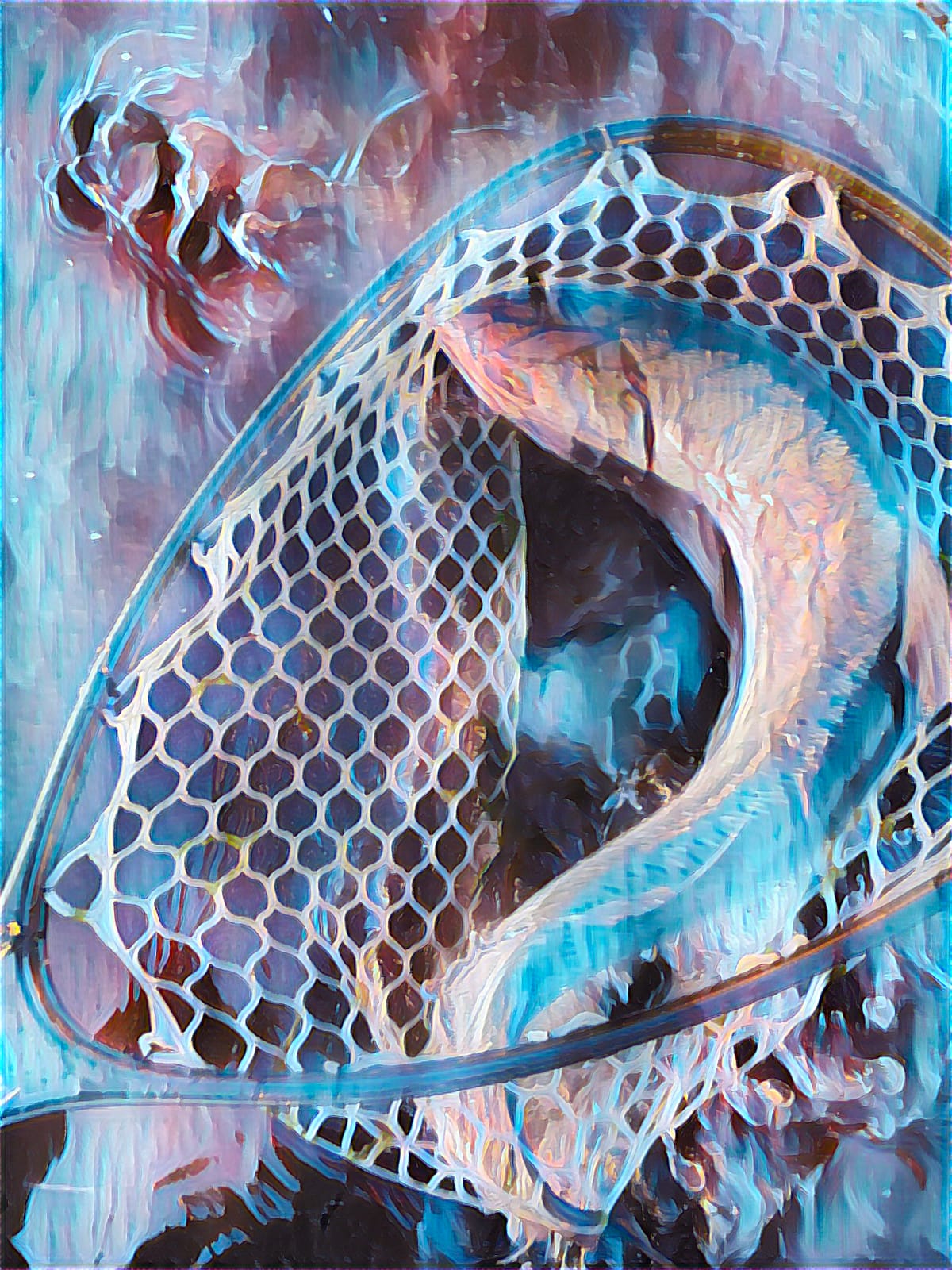
A fish attacks my fly with such anger and weight that it bends my sturdy rod in half. It’s deeply impaled itself on my hook and immediately darts for deep water, towards the glowing orange and blue mountains. The coho is powerful, fast, and is ripping line off my reel. I let it run. I bring her in, and I let her out again. This fish is no slouch; it’s not lazy like some of the coho I’ve landed in the past. This fish is fresh, hardy, and not going to give up and flop over. It wants a fight. I manage to tire her out after two to three minutes of fighting; of course, it feels much longer. She makes a final run towards freedom and clears the sea one more time. Gently, I bring her back to shore and steer her into my rubber net. As I remove the hook from the side of her mouth, we lock eyes, and I sense something human in her. It’s a strange sensation. As I take her by the tail and move her back and forth in the water, reviving her, I think about how I’m thankful for the hard, clean fight and release her back into the cold water. She’s simply grateful to be on her way.